Tuesday, July 16, 2013

Staying for Lunch

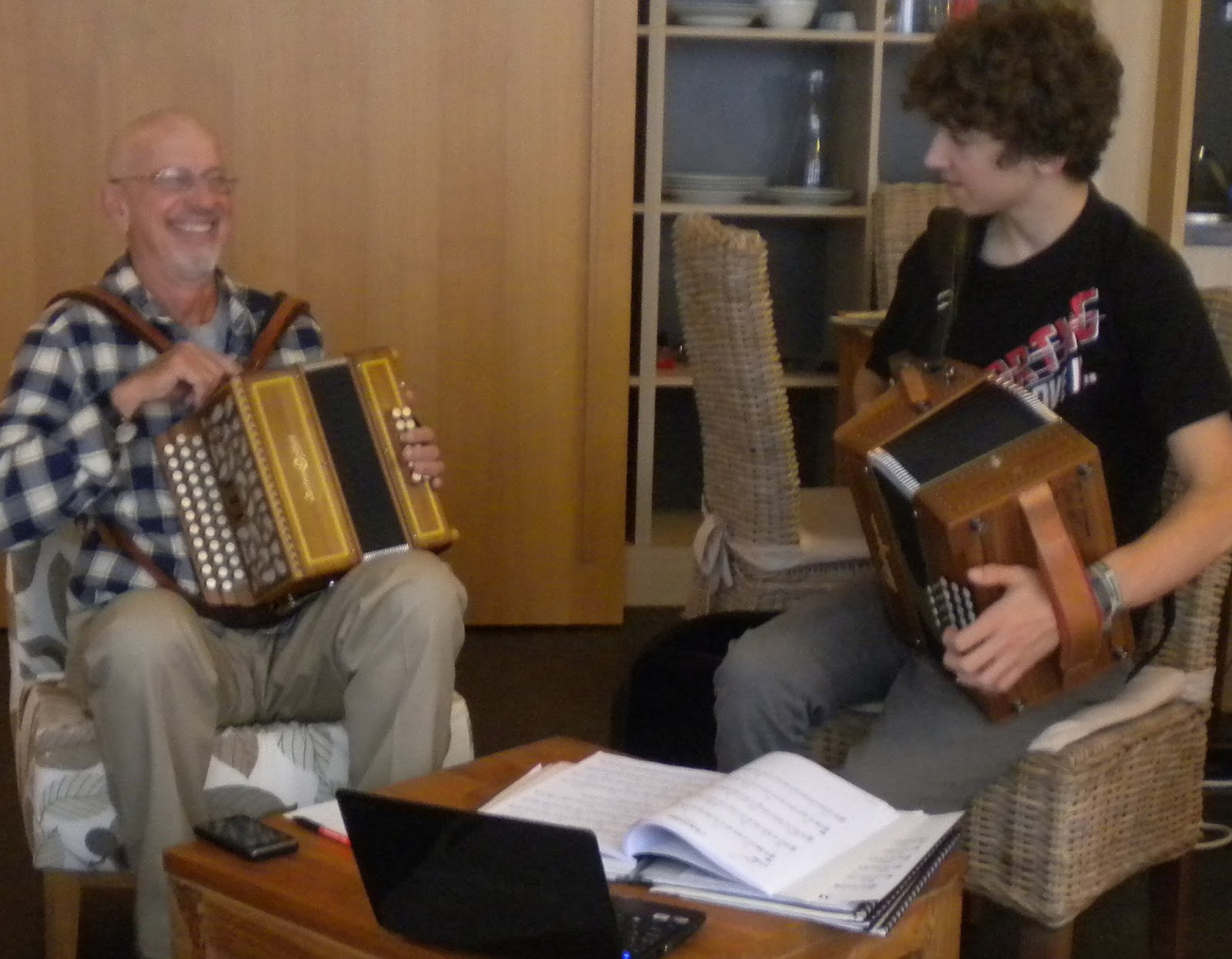
Guus and Hilde in duet
Hilde invited me to stay for lunch, and then for a concert, and then for a ride to Brussels train station, proving that good things can come in threes.

In retrospect I may have invited myself by arranging a lesson with her son Guus for 11:00, as if lunch were not part of the daily routine in Belgium.

Ah, those presumptuous bumbling Americans. But Hilde made me feel perfectly welcome and we had a delightful time. Ah, those gracious Continentals with manners as smooth as a silky Bearnaise, who can step up to the lunch plate and hit a home run with so little visible effort -- to mix several metaphors.

Brussels harp until the Lennik bus.
Guus declared himself pleased to hear my progress on Music Mazurka. He then helped me see that my timing and articulation were off the mark; though sometimes, in a blind pig moment, I was managing to find the right note at the right time. I felt humbled that my dozen or so hours working on this tune's first sixteen measures produced such modest results. But I was inordinately encouraged by his comment.

He helpfully pointed out that I was tapping my foot for a waltz but trying to play a mazurka. My left ankle is my metronome and I had set it to a steady oom, pa, pa. While he played Music Mazurka, he and I tapped out the tune's pulse of two beats separated by a pause. I found it to be rather like the lub-dub of a slowly beating heart. He played a faster mazurka, switching from what my friend Anja terms the smoochy romantic type to the traditional bouncy type, and it became more like a marathon's heart. Same pattern but with a galloping rhythm. It sounds easy but convincing my ankle-metronome to mazurka as I play will take some doing.

After the lesson, we sat in the garden to an informal spread of fruit, sandwich makings, and drinks, chatting in English. My hosts occasionally held a side conference in Dutch (or perhaps Flemish) to work out the translation of a difficult word or concept. The Trappist beer I quaffed was excellent and I relaxed into contented realization that cruising really is about the people. Sightseeing and experiencing places like Ghent are merely the context of this summer. Luncheon moments like this are really why I ventured into these waters.

For dessert Hilde and a friend, Bernard, each played tunes, with Guus vamping the accompaniment or playing counterpoint. Hilde and Bernard both started diato recently and occasionally fumbled, as do I. But they both played with a style and rhythm that I hope to emulate. (Since then Anja commented that Hilde took up the accordion about three weeks prior to our lunch and had attended Pascale Rubens' workshop the previous week.) Aye yi yi, I am immeasurably impressed by Hilde's progress. We do share Guus as a tutor but her music gene must be dominant whereas mine feels recessive..

As an encore -- I really did my role as audience to the fullest and gave Hilde and Bermard a standing ovation -- Guus broke out of the supporting role and launched a pulsing Scottish that simply begged for participation. Hilde and Bernard danced barefoot in the grass.

By the end of summer I hope to be on the dance floor myself. That seems a possibility as Leen Devyver, a well-known balfolk dance instructor, is willing to give Anita and me a mazurka lesson. Plus, I will attend many Boombal Dansinitiatie next week during Gentse Feesten.

Monday, July 15, 2013

Gunkholing Diatonia

"No tram pass for visitors. It is residents only. Do you want to buy a ticket?" The agent said this with a touch of impatience and I felt the implied pressure of the travelers in line behind me, needing to catch their own trains. Despite the ticket agent's certainty, I knew that he was misinformed. As it turned out I was in the wrong line, at the wrong place, at the wrong time. I should have been in the De Lijnwinkel line at Kornmarkt later that afternoon.

I do love passes and librarians when I travel. Both are terrific resources that help take the angst out of exploring out-of-the-way places. So, on that first morning in Sint-Pieters train station in Ghent, I had joined the ticket queue, intending to purchase an annual tram and bus pass. It is so inexpensive that there was no concern about our leaving Belgium well before it expired. The price is a sort of reward for those of us who have survived sixty-five trips around the sun -- a bit like Delta's SkyMiles being a reward for all those hours waiting in airports.

Morning croissants are just across the street.
This country certainly does cater to a senior's travel needs. Round trips on Belgium trains are six euros, with only a few restrictions, like leaving after 09:00. To my mind, this is not so much a restriction as the truly sensible advice to have a leisurely coffee and croissant with fresh orange juice rather than setting an alarm and rushing to the station.

An annual De Lijn bus and tram pass is 36 euros. To put that in perspective, riding Atlanta's MARTA for a year would cost ten times more and be restricted to one city, whereas De Lijn seems to go most everywhere in northern Belgium, including Antwerp, Brussels, Bruges and all the tiny towns all about. I had read about this pass in the states, puzzling through Google Translate's English version of De Lijn's Dutch explanations. But on our arrival this ticket agent firmly declared that such a pass was not possible for visitors. No way. Only Belgium citizens qualified. The helpful Tourist Information office regretfully concurred.

Previously our local friend Anja had graciously visited De Lijnwinkel (De Lijn's store) and emailed that indeed, we needed only a passport and euros. Fortunately, the De Lijnwinkel agent herself agreed and we emerged a short time later clutching our magic cards. As gunkholers we have been cruising Belgium, using the trains like a mother ship for arriving and De Lijn like a dinghy for exploring. 

Yes, there was a concert.
Plus, in Ghent we hop on and off trams as if we belonged. A couple of days ago I found myself helping some Spaniards navigate the system. They asked in French, thinking we were locals, and we answered in our pidgin patois. The trouble was that neither side actually spoke any French. By the time I switched to using my dimly-remembered high school Spanish, my vocabulary had been thoroughly trampled by the effort of making up French-sounding words. In the end we pointed to the approaching #1 tram and nodded, thus resorting to a universal sign language. I do hope they made their train connection.

Last week we called on Harelbeek, where we sat at a frites table with Toon Van Merlo and Pascale Rubens and chatted about why we were hanging about that tiny town -- to hear them play, of course -- and got invited to come over to their house for a drink sometime. They were very gracious and Toon seemed totally bemused at the idea of my spending the summer, stalking the mazurka. 

This after we stepped off the train in Harelbeek only to discover that there was no Naragonia concert. Several shopkeepers declared that the only concert was the last weekend or perhaps the next, certainly nothing like that on Tuesday evening. Disconsolate, we wandered about peering into closed stores and thinking about when the next train might take us back to Ghent. 

Dancing to Naragonia.
On impulse we stepped into the library and chatted up the librarian. She regretfully agreed, no concert, until I mentioned bells; Naragonia Duo was to be accompanied by a carillon. The librarian and a colleague did the research, confirmed the schedule, and pointed the way toward a steeple full of bells. Local librarian knowledge at its best.

As we sat admiring the bell tower, the oncoming twilight and the dancers, Naragonia played my favorite mazurkas. It was simply entrancing.


Sunday, July 7, 2013

Gooikoorts Festival

Brilliant blue sky and a sign pointing to the water closets,
 what more could one ask?
"Yes, that is a waltz. But smoother and not so bouncy." I was playing what I had intended to be a waltz. This comment made me think that I might be making progress on my musical journey. The speaker, a dancer and an instructor, had previously stated that in her opinion too many musicians play for musicians rather than dancers.

Gooikoorts is one of the many European weekend music festivals this summer. Held in Gooik, a small town about 25 km west of Brussels, it was a first. I had seen pictures and video of festivals but never before observed the mazurka in its natural habitat.

Spelling it is easy but saying it?
To get to Gooik, we ventured out from our apartment early on a Sunday, clutching elaborate handwritten instructions enumerating the tram, train and buses we would take. This paper was to show the various conductors and drivers so they could nod yes or point us in the right direction. Remembering which platform or stop at which to stand, the destination to be shown on the front of the vehicle and the name of the stop can be a challenge, so the list was helpful.

Pronouncing those place names in a question? Totally impossible. Over and over we have experienced asking, "Is this the bus to Enkhuizen?", or the like only to be answered with a puzzled look followed by, "Where?" This from trilingual speakers whose English sounds like it is straight from the USA. Or sometimes a bit like Homer Simpson or other TV characters, since shows for the Dutch audience are subtitled rather than dubbed and children pick up their accents from, well, us in all our diversity.

Pointing to the same name on a map or scrawled on my cheat sheet always resulted in an answer like, "Ah you want Enkhuizen . . . " To my ear it was the same word, but to the Dutch ear, obviously not so. Perhaps my Texan drawl is incompatible with de-voiced consonents and diphthongs that sound only superficially like their English equivalents.

Naragonia Quartet at Gooikoorts Festival
The highlight of Gooikoorts Festival was Naragonia Quartet's concert. Anita, bless her heart, managed to score two seats up front by scooting into the tent moments after they raised the flap. Wow. I glanced up on stage and there was Pascale Rubens, arranging accordions. Close enough to touch, those three Castagnaris.

As we were waiting, I struck up a conversation with Anita (a different Anita, this one from Holland) about Naragonia's music, why we were at the festival, and my wanting to learn to dance. This led to her offering to teach me at the ball that evening. Alas, when I consulted my paper, it said that we had a bus to catch well before the dancing started. As a consolation, Anita mentioned that she had taught a workshop for musicians to help them play for dancers and offered me a similar session after the concert.

Wilko plays a waltz and a mazurka
Anita and Wilco demonstrated waltz and mazurka, she dancing and he playing hurdy gurdy. Then I outed my box from its new Visseur carrying case and tried it myself. My Valse Tarde passed muster but my Valse des Jouets was declared to be more like a mazurka than a waltz.

So, at last I had finally played a tune that the listener thought to be a mazurka, even though by accident. Definite progress.

Wednesday, July 3, 2013

Three Melodions in One Room


Tine and Anja are astoundingly musical
I spent a magical evening in a room crowded with diatonic accordion players. I do believe that three's a crowd applies here, in the most delightful way possible. There we were, three of us holding melodions in our laps: a Castagnari, a Serafini and my Gaillard. It was a veritable who's who of G/C diato makers.

Anja, our Ghent friend, invited Anita and me to a session at Tine's flat, which turned out to be a 15- minute walk from Ballenstraat in a misty drizzle. Well, it could have been a five-minute tram ride but we rushed to the wrong side of the street on the advice of a local, who misunderstood our destination. We arrived at the opposite stop barely in time to watch our tram slide by where we had been standing, moments before. Local knowledge is invaluable on a cruise, despite sometimes being way wrong. We relearned a valuable lesson: ask the right questions and check the charts to be certain you know what you are getting into. It happens.

For the first time in my 67 years -- it was my birthday, after all -- I was with others who actually play mazurkas. Until then YouTube was the only exposure to players. Not to diminish the YouTube experience, but it pales in comparison with actually being there.

Anja and Tine are session buddies and accomplished players. They graciously allowed me to barge into their evening. Hearing them interweave tune and accompaniment made this entire trip worthwhile. Everything else this summer will be frosting on the delicious musical birthday cake that they served up.

Guus makes a mazurka dance
That evening occurred after my first lesson by Guus, a gifted young player who has agreed to coach my diato journey. He started by playing my Gaillard and produced the most astounding music. I had no idea it could sound like that, bouncy and rhythmic, with lots of punch. Nothing wrong with the accordion, Guus declared.

Then he had me play a mazurka or two, same box, different fingers. What a contrast. We agreed that my tunes shuffled slowly around the room as if in a daze, mostly landing on the wrong foot at the wrong time and occasionally sprawling on the floor with an embarrassing splat. I could certainly hear the difference between his version and mine: articulation, dynamics, phrasing, ornamentation, syncopation, harmony and swing, to name a few of the techniques which I should master. Ah, well. That's what this cruise is all about.

I'm confident that Guus will help me improve. Plus, I got the impression he believes there is lots of low-hanging fruit on my musical vine, which is to say that I could make progress in every area. He has bravely signed up for another session a couple of weeks from now.

Now I'm reviewing the video from our first lesson, studying how he grabs a tune, shakes it awake and makes it dance. His virtual fingers never tire and he doesn't mind when I stumble along in his wake. I'm trying to feel Pascale Rubens' Le lac de St-Croix in a new way so that I can land on the right foot at the right time. With any luck I'll be able to replace this rendition with a version that makes a listener think, ah, he's playing a mazurka.

Saturday, June 29, 2013

Kaffe, as in Safe

The Fashion and Textile Museum in London
London's Fashion & Textile Museum bustled on a rainy Friday afternoon, chock full of Kaffe Fassett aficionados. Anita blended well with the attendees. Like cruisers, they tend to run to a type: short-haired women of a certain age, wearing mostly natural fibers dotted here and there with splashes of color.

The exhibition was overwhelmingly colorful, like the documentaries of India showing ceremonies that involve pots of vivid dies. The walls were festooned with pillows, sweaters, paintings, fabrics and other monuments to a life devoted to exploring colors and how they change one another when brought together. Fascinating stuff, especially if you are a quilt, knit, crochet type.

A profusion of color by Kaffe Fassett
After an hour or so of textiles I found a semi-comfortable chair and settled in for an afternoon's nap. It being around 6 am in Atlanta and me still having one foot in eastern time made it easy to drift off. I had wondered whether to lug along the u-shaped neck pillow I had used on the flight from Atlanta. I decided I wouldn't need it and left it behind in Ghent. Big mistake.

When I awake the plan is to head off to the V&A for more texture, color and design. Anita is having a terrific time and I'm looking forward to more adventures in London, including a jaunt to the upper-end fabric mecca, Liberty of London. I suspect we will shed a few pounds there, for sure.

Brilliant is my new Briticism, learned in Liberty of London where Anita acquired pounds of lint in various colors and weaves at astounding prices. Even when I squinted at the numbers and pretended they were dollars rather than sterling it was impressive. After accumulating several royal purple LL bags we trekked to the VAT refund desk. A young woman coached us through the stamping of receipts and filling of forms. To each of our answers she responded, "Brilliant," which I gather means uh huh, but is so much more posh-sounding. Later we discovered she had neglected to tuck the VAT form in the LL envelope. Not so brilliant, that.
Liberty of London, yarn mecca.

Stalking the Mazurka

"I recognize the tune, but It doesn't sound like a mazurka." This devastating comment, emailed last spring by a friend in Belgium, sharply focused the purpose of this cruise. By the end of summer I hope to be able to play a recognizable mazurka and dance the same, to tunes by Naragonia, a duo who play exquisite diatonic accordion. All this in Ghent, Belgium.


Anita's on-board meal was different than mine.
This is our first cruise aboard a dirt yacht rather than Sweet Pea. As a result, our Atlantic crossing involved only a single overnight watch -- I suppose that I can claim watching movies aboard Delta is a watch and I did stay awake for the entire night. For various reasons -- mainly due to a shortage of SkyMiles, leading to only one "free" ticket -- Anita snoozed two rows ahead of me in decadent luxury while I suffered in Coach with a bag of peanuts.

We landed in Brussels, dizzy with time warp, and navigated trains to our flat in Ghent. The summer's cruise has started.


Now, having stowed our bags in Ghent, we're streaking east across France on the Eurostar, headed for London. This is to be Anita's treat: a museum crawl to satiate a textile itch. We'll start with Kaffe Fassett's exhibition of quilt and color in the Fashion and Textile Museum and then tube over to the Victoria and Albert Museum for a couple of days. Lotta tangled threads in my future.

Next week I hope to meet with my musical coaches -- why hire only one mazurka consultat when three are available? -- hear Naragonia in concert and play tunes with Anja, the Ghent friend who has been incredibly helpful in understanding how to do this cruise.

As the cruise guides always say, the prudent mariner seeks local knowledge. A year ago on melodeon.net I posed the question of where to study diato. That opened the door to a flood of advice, including a tip from Chris Ryall that a university town like Ghent would be ideal. Anja, a Ghent based melnetter chimed in with where to stay, how to get around the town and the country, which festivals to attend, and who might give music lessons.

We took a flat in Patersol, Ghent's charming old section, full of restaurants and bars on cobblestone streets that are mostly empty of cars, with a tram stop at the end of our street. I have lined up diato lessons with Guss, a recent graduate with a degree in music who wants to start giving accordion lessons and is an accomplished dancer. And, the biggest of the Belgium music festivals is held in Ghent. Without such good advice I would have already hit the shoals. Instead we're well underway and already having fun.

Friday, February 1, 2013

Community Carnitas

Last night was Sweet Pea's chance to sponsor a social event at the fire pit, which is Jekyll Harbor Marina's gathering place for the cruisers and comes complete with gas grill. We did Mexican slow-fried pork tacos also known as carnitas. Here's how.

For 20 people start with:
  • 5 lbs. pork shoulder (Boston Butt) or similar inexpensive cut of pork roast, the fattier the better.
  • Aluminum foil turkey roasting pan
  • Spices: cumin, cinnamon, chili power, oregano, rosemary, ground black pepper
  • 3 limes
  • 1 cup of any liquid: cola, orange juice, water
  • Vegetable oil or similar cooking oil
  • Flour tortillias
  • Taco garnishes, provided by guests: chopped cilantro, cheese, sour cream, avocado, salsa, lime wedges, radish slices, etc.
Prepare the pork:
  • Mix spices to form a rub, gauging quantities by eye and inclination.
  • Cut pork into chunks, approximately 2 - 3 inches in size.
  • Place pork chunks in aluminum foil pan and coat all surfaces with the spice mix.
  • Arrange the pork chunks around the side of the pan to create a small cavity in the center.
  • Squeeze in several limes and then add the rinds to the cavity.
  • Add 1 cup liquid -- I used Coca Cola since it was on hand and might even add a complex flavor but orange juice or water also works.
Cook the pork:
  • Place foil pan on gas grill or oven.
  • Add cooking oil to cover pork.
  • Roast at 250 to 300 degrees Fahrenheit for 2-3 hours until much of the water is evaporated.
Initially the liquid will simmer as the heat evaporates the water, holding the temperature to 212 degrees. Ideally this step will take about 2 hours, producing a fork-tender meat that is easily shredded but with a soft crust.

When the water is mostly evaporated there will be fewer steam bubbles -- the simmer will appear to slow down -- and as a result the temperature of the oil will begin to rise, crisping the pork. If this final step is extended too long, the meat will gradually become dry and tough, so monitor by periodically tasting to gauge the optimal balance between a succulent fall-apart tender interior and crispy outside. Use a beer or wine to refresh the palate between tastings, just to be sure.

Make the carnitas:
  • Remove the pork chunks and discard the oil. Use extreme caution when handling the hot oil.
  • Return pork to the pan and hold in the warm grill along with a stack of flour tortillas.
  • Shred pork prior to placing on a warm flour tortilla.
I like to set up an assembly station, using the open gas grill set to its lowest heat. Nestle the pork chunks in one end of the drained aluminum pan and put a heat-proof plate stacked with warm tortillas in the other end. Using a spatula and tongs, shred the pork in the center of the pan and place a generous serving on the top-most tortilla. With the spatula and tongs, fold the tortilla so that the person you are serving can lift it by the top edges, without touching the rest of the stack. Between servings close the grill to keep the ingredients warm.

Despite starting with a fatty cut of pork and simmering it in oil, the results are not greasy -- perhaps the marbling renders from the meat in the final step and is discarded with the oil. Squeezing a lime wedge over the carnita helps balance the pork's richness and adds an acid bite.